Indian Railways New Penalty Rules 2026: Rs 500 Fine for Ticketless Travel & What Else Changed
From July 1, 2026, Indian Railways doubled its ticketless travel fine to Rs 500 plus fare, with Rs 2,000 penalties for smoking and hawking. Here is the full new penalty list and how to stay clear of it.

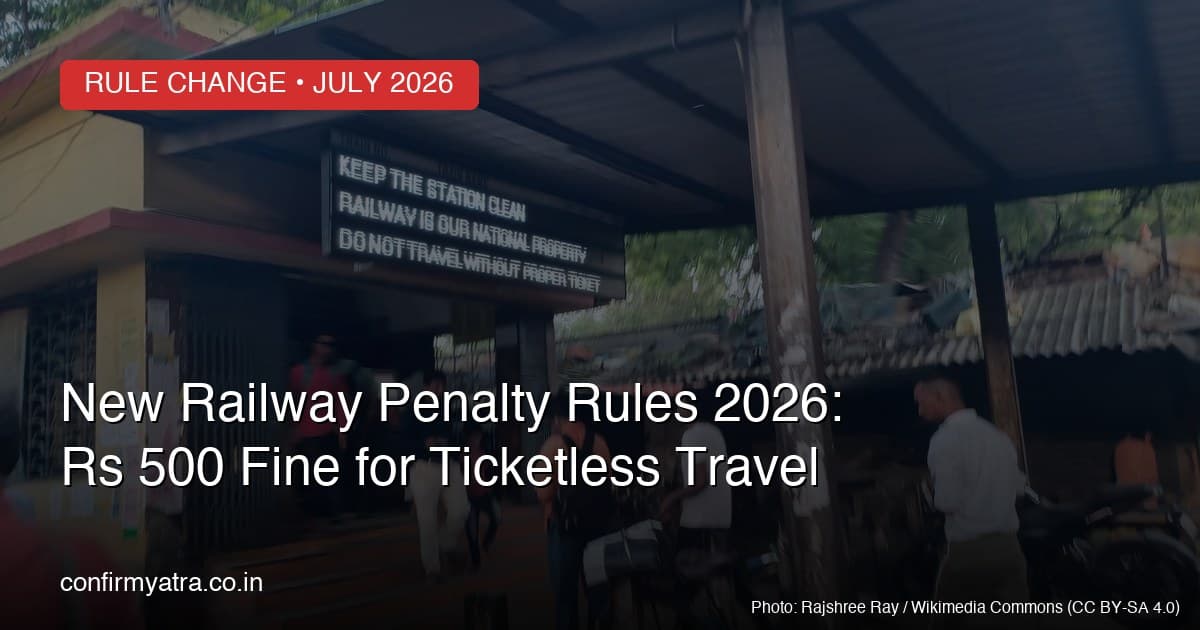
Last month my cousin hopped onto a local train two stops without buying a ticket — something half of us have done at some point, telling ourselves we will just pay if a checker shows up. He got caught. The old fine was Rs 250 plus the fare, annoying but survivable. Do that same thing today and it costs a lot more, because the rules quietly changed on July 1, 2026.
If you travel by train in India, these are the new numbers you actually need to know — not the legal jargon, just what it now costs when things go wrong.
What Changed on July 1, 2026
Indian Railways revised its penalty structure under the Jan Vishwas (Amendment of Provisions) Act, 2026, which updated Sections 137 and 138 of the old Railways Act of 1989. In plain terms: the fines that had not moved in years were sharply increased to discourage ticketless travel and other offences, and to reduce the revenue the railways loses to fare-dodging every year.
The single biggest change most passengers will feel: the minimum fine for travelling without a valid ticket is now Rs 500, doubled from the earlier Rs 250 — and that is on top of the actual fare for your journey.
The New Railway Penalty List (2026)
Here is the updated penalty chart for the most common offences:
| Offence | New Penalty (2026) | Earlier | |
|---|---|---|---|
| Travelling without a valid ticket | Rs 500 minimum + actual fare | Rs 250 + fare | |
| Travelling beyond your booked destination | Rs 500 minimum + fare for extra distance | Rs 250 + fare | |
| Travelling on an improper pass or wrong ticket | Rs 500 minimum + fare | Rs 250 + fare | |
| Smoking in trains or at stations | Rs 2,000 | Nominal / rarely enforced | |
| Unauthorised hawking or vending | Rs 2,000 | Lower slab | |
| Drunken or nuisance behaviour | Rs 1,000 fine or up to 24 hours detention | Lower |
If a matter goes to court, the maximum punishment for serious or repeat offences can still reach up to six months imprisonment, a fine, or both — that part is decided by a magistrate, not the checker on the train.
The Ticketless Travel Fine, Explained Simply
This is the one that affects the most people, so it is worth being precise.
If the Travelling Ticket Examiner (TTE) finds you without a valid ticket, you now pay a minimum of Rs 500 as the penalty, plus the fare from your boarding station to your destination. The word "minimum" matters — for longer journeys or higher classes, the penalty can be more than Rs 500, but it will not be less.
A few situations people often misjudge:
- Boarding without a ticket "just to catch the train": Still counts as ticketless travel. Buying onboard is not guaranteed and does not avoid the penalty if a checker reaches you first.
- Sitting in a higher class than booked: Treated as travelling on an improper ticket — penalty plus the fare difference.
- Getting down beyond your booked station: You owe the fare for the extra distance plus the penalty.
- A waitlisted e-ticket that never confirmed: An e-ticket that stays fully waitlisted after charting is automatically cancelled and is not valid for travel — boarding on it is treated as ticketless. Always check your PNR status before heading to the station.
Smoking, Hawking and Nuisance — Now Rs 1,000 to Rs 2,000
The bigger jumps are actually in the "behaviour" offences that were barely enforced before:
- Smoking anywhere in the train or station premises: Rs 2,000.
- Unauthorised hawking (selling goods on trains or platforms without a licence): Rs 2,000.
- Drunken nuisance or disturbing other passengers: Rs 1,000, and in some cases detention for up to 24 hours.
These were long treated as minor, informal matters. Under the 2026 rules they carry real, standardised fines — so the "nobody actually gets fined for this" assumption no longer holds.
Why the Railways Raised the Fines
Two reasons, both worth understanding. First, ticketless travel costs Indian Railways a large amount in lost revenue every year, and the old Rs 250 fine was small enough that many people simply treated it as a gamble worth taking. Doubling it changes that maths.
Second, the Jan Vishwas Act is a broader government exercise to modernise old laws — many penalties across different sectors were sitting at decades-old amounts that no longer meant much. The railway fines were updated as part of that same clean-up.
How to Stay Completely Clear of These Fines
None of this is a problem if your ticket situation is clean. A few simple habits:
1. Always carry a valid ticket and a matching photo ID. For e-tickets, the ticket on your phone plus the ID used at booking is enough — you do not need a printout.
2. Confirm your status before you travel. If you booked a waitlisted or RAC ticket, check your PNR status close to departure. A still-waitlisted ticket is not valid to board.
3. Know your booked class and destination. Do not "upgrade yourself" into an empty AC seat or ride past your station without settling the difference with the TTE first.
4. If plans change, extend properly. You can pay the TTE for a legitimate extension of journey or change of class — doing it proactively is not a penalty, getting caught is.
5. Understand the wider booking rules too. Our guide to IRCTC booking rules and limits covers ID requirements, child tickets, and boarding-point rules that also affect whether your ticket counts as valid.
Frequently Asked Questions
What is the new fine for travelling without a ticket in Indian Railways?
From July 1, 2026, the minimum penalty for ticketless travel is Rs 500 plus the actual fare for your journey — double the earlier Rs 250 minimum. For longer or higher-class journeys the penalty can be higher, but never lower than Rs 500.
When did the new railway penalty rules come into effect?
The revised penalties took effect on July 1, 2026, under the Jan Vishwas (Amendment of Provisions) Act, 2026, which amended Sections 137 and 138 of the Railways Act, 1989.
How much is the fine for smoking on a train or at a station?
Smoking in a train or within station premises now carries a fine of Rs 2,000 under the 2026 rules — a significant increase from the earlier, rarely-enforced nominal charge.
Is a waitlisted e-ticket valid for travel?
No. An e-ticket that remains fully waitlisted after the chart is prepared is automatically cancelled and refunded, and is not valid to board. Travelling on it is treated as ticketless travel and attracts the Rs 500 penalty plus fare. Always check your PNR status before travelling.
Can I pay the fine on the train, and what if I cannot pay?
Yes, the TTE can issue a penalty receipt onboard and you can pay then. If you are unable to pay, the matter can be referred to a railway magistrate, where the maximum penalty can rise to up to six months imprisonment, a fine, or both — so paying the on-the-spot penalty is almost always the smaller outcome.
Does the Rs 500 fine apply to unreserved and local train travel too?
Yes. The ticketless travel penalty applies across reserved, unreserved, and suburban/local services. Even for a short local journey, boarding without a valid ticket now carries the Rs 500 minimum penalty plus fare.
Before your next journey, check your PNR status, track your train live, and confirm seat availability on ConfirmYatra — so the only thing you carry onboard is a valid ticket.
Plan your journey with ConfirmYatra
Free real-time tools for Indian Railways travellers.