Rath Yatra 2026: Date, History, Rituals and the Story Behind Lord Jagannath's Chariot Festival
Rath Yatra 2026 falls on July 16 in Puri. Here is the real story behind the world's largest chariot festival — its history, rituals, three sacred chariots, and why millions pull the ropes.

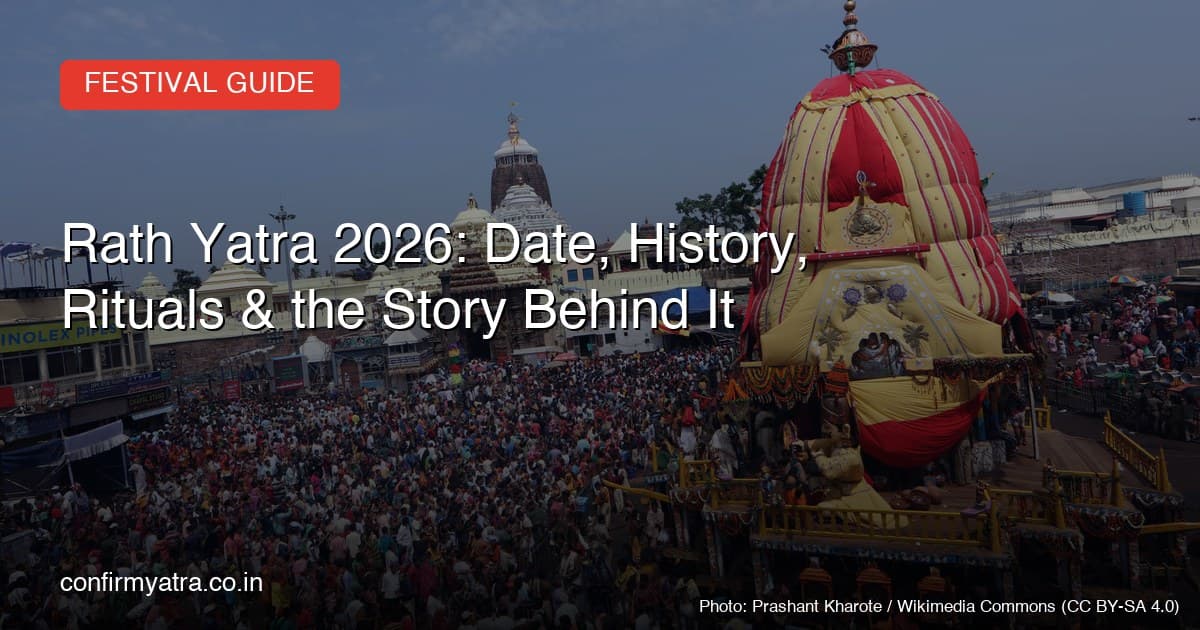
Once a year, three wooden chariots taller than a four-storey building roll out of a temple in a small coastal town in Odisha, and hundreds of thousands of people drop everything to pull them with their bare hands through the streets. There is no ticket, no invitation, and no restriction on who can join. That is Rath Yatra — and in 2026, it happens on July 16, in Puri.
If you have ever seen the photos or videos — a sea of people surrounding a massive red-and-yellow chariot, ropes as thick as a human arm being hauled by thousands of hands at once — and wondered what it actually is, here is the full story.
When Is Rath Yatra 2026?
Rath Yatra 2026 falls on Friday, July 16, marking the Dwitiya Tithi (second lunar day) of Shukla Paksha in the Hindu month of Ashadha. It is not a single-day event — the festival stretches across nine days, ending with the Bahuda Yatra (the return journey of the deities to the main temple) on July 25, 2026.
In the days before the main procession, another ritual called Snana Purnima takes place, where the deities are ceremonially bathed with 108 pots of sacred water — a purification rite that precedes the main festival by about two to three weeks.
The Story Behind Rath Yatra
The tradition traces back to the 12th century, when King Anantavarman commissioned the construction of the Shree Jagannath Temple in Puri. But the roots go deeper than architecture. The chariot procession of Lord Jagannath is documented in ancient Hindu scriptures — the Skanda Purana, the Brahma Purana, and the Narada Purana all describe this journey.
The name "Jagannath" comes from two Sanskrit words: *Jagat* (universe) and *Nath* (lord or master) — literally, "Lord of the Universe." Unlike most temple deities who stay inside the sanctum, Lord Jagannath, along with his elder brother Lord Balabhadra and sister Devi Subhadra, steps out once a year to travel among ordinary people. That single detail is what makes Rath Yatra different from almost every other major Hindu festival — the god does not wait for devotees to come to the temple. The god comes to the street.
The declared destination is the Gundicha Temple, about three kilometers away, believed to be the deities' aunt's home. The three chariots make this journey together, pulled entirely by hand.
The Three Chariots
Every year, three new chariots are built from scratch using wood from specific trees, following construction rules passed down for generations. None of the chariots use a single nail — everything is wooden joinery.
- Nandighosha — Lord Jagannath's chariot, the tallest of the three at nearly 45 feet, wrapped in red and yellow cloth.
- Taladhwaja — Lord Balabhadra's chariot, slightly shorter, wrapped in red and green.
- Darpadalana (also called Devadalana) — Devi Subhadra's chariot, wrapped in red and black.
Each chariot has multiple thick ropes attached to it, and thousands of devotees grab hold at once. The synchronized pulling, the chanting of "Jai Jagannath," and the sheer scale of the crowd is what gives Rath Yatra its reputation as one of the most visually overwhelming religious gatherings anywhere in the world.
The Rituals That Unfold Over Nine Days
Pahandi — Before the chariots move, the deities are carried from the temple sanctum to their respective chariots in a slow, rhythmic, swaying procession accompanied by drums and conches. This alone can take hours given the size and weight of the idols.
Chhera Pahara — Perhaps the most symbolically loaded ritual of the day. The Gajapati King of Puri — a descendant of the traditional royal line — arrives at the chariots and personally sweeps the platforms with a golden broom before the procession begins. The message embedded in this act is direct: before the Lord, even a king is a servant. Everyone, regardless of caste or status, is equal.
Pulling the ropes — This is the part most people recognize from photos. According to belief, anyone who pulls or even touches the ropes of the chariots is freed from sin and released from the cycle of birth and death. This is precisely why the ropes are open to everyone — there is no restriction based on faith, background, or nationality. It is one of the few major religious rituals in India where mass, unrestricted physical participation is the entire point.
Why Millions Show Up Every Year
Strip away the ritual details and Rath Yatra's core idea is simple: the divine leaving its usual boundaries to become reachable by everyone, and everyone being invited to physically take part rather than just observe. That combination — spectacle, inclusivity, and a promise of spiritual merit for simple physical participation — is a big part of why the crowd at Puri regularly runs into the hundreds of thousands, with some estimates for the main day going well beyond a million people across the nine-day period.
Rath Yatra Beyond Puri — A Festival That Travels the World
While Puri hosts the original and largest Rath Yatra, the festival is far from confined to one town.
Ahmedabad hosts one of India's largest Rath Yatras, running since 1878 from the 400-year-old Jagannath Temple in the Jamalpur area. The Gujarat procession covers roughly 18 kilometers through the old city, led by around 15 to 20 decorated elephants and followed by tableaux trucks depicting mythological scenes — a scale that draws massive crowds every year.
Kolkata, particularly through ISKCON, hosts another major Rath Yatra procession that has grown significantly over the decades.
Globally, Rath Yatra has been celebrated in major cities since 1967, when the International Society for Krishna Consciousness (ISKCON) began organizing chariot festivals abroad. Today, versions of the procession take place on the streets of London, Paris, Sydney, Tokyo, San Francisco, and along New York's Fifth Avenue — making Rath Yatra one of the very few Indian festivals with an organized, decades-old international presence.
Planning to Witness Rath Yatra in Puri This Year
If the story above has you thinking about actually being there, Puri during Rath Yatra is not a casual day trip — the crowds, train bookings, and hotel availability all need planning well in advance. Indian Railways runs special trains for the festival period from major cities, and general quota seats on regular trains to Puri sell out fast in the weeks leading up to July 16.
We have a separate, detailed guide covering exactly that — special trains, routes, and how to book your way to Puri for Rath Yatra 2026 — worth reading before you finalize your trip.
Frequently Asked Questions
What is the date of Rath Yatra 2026?
Rath Yatra 2026 falls on Friday, July 16, in Puri, Odisha. The full festival period runs for nine days, concluding with the Bahuda Yatra (return journey) on July 25, 2026.
Why do people pull the chariot ropes at Rath Yatra?
According to tradition, anyone who pulls or even touches the ropes of the chariots during Rath Yatra is believed to be freed from sin and released from the cycle of birth and death. This belief is why the ropes are open to all devotees without restriction.
What are the names of the three Rath Yatra chariots?
The three chariots are Nandighosha (Lord Jagannath's chariot, nearly 45 feet tall), Taladhwaja (Lord Balabhadra's chariot), and Darpadalana or Devadalana (Devi Subhadra's chariot). All three are rebuilt from scratch each year using traditional wooden joinery with no nails.
What is Chhera Pahara?
Chhera Pahara is the ritual where the Gajapati King of Puri sweeps the chariot platforms with a golden broom before the procession begins, symbolizing that everyone — including royalty — is equal before Lord Jagannath.
Is Rath Yatra celebrated only in Puri?
No. While Puri hosts the original and largest Rath Yatra, major processions also take place in Ahmedabad (since 1878) and Kolkata, and internationally in cities like London, Paris, Sydney, Tokyo, San Francisco, and New York since ISKCON began organizing global celebrations in 1967.
How do I travel to Puri for Rath Yatra 2026?
Indian Railways runs special trains to Puri during the festival period, in addition to regular trains from Delhi, Mumbai, Kolkata, and Bangalore. Read our complete guide on special trains and how to reach Puri for Rath Yatra 2026 for routes, booking tips, and station details.
Check PNR status, track live trains, and search seat availability on ConfirmYatra — India's fastest railway information platform.
Plan your journey with ConfirmYatra
Free real-time tools for Indian Railways travellers.