Kavach: How Indian Railways Prevents Train Collisions in 2026 — Explained Simply
Kavach is India's home-grown anti-collision system that automatically brakes a train before disaster. Here is how Kavach works, where it is live in 2026, and what it means for your journey.

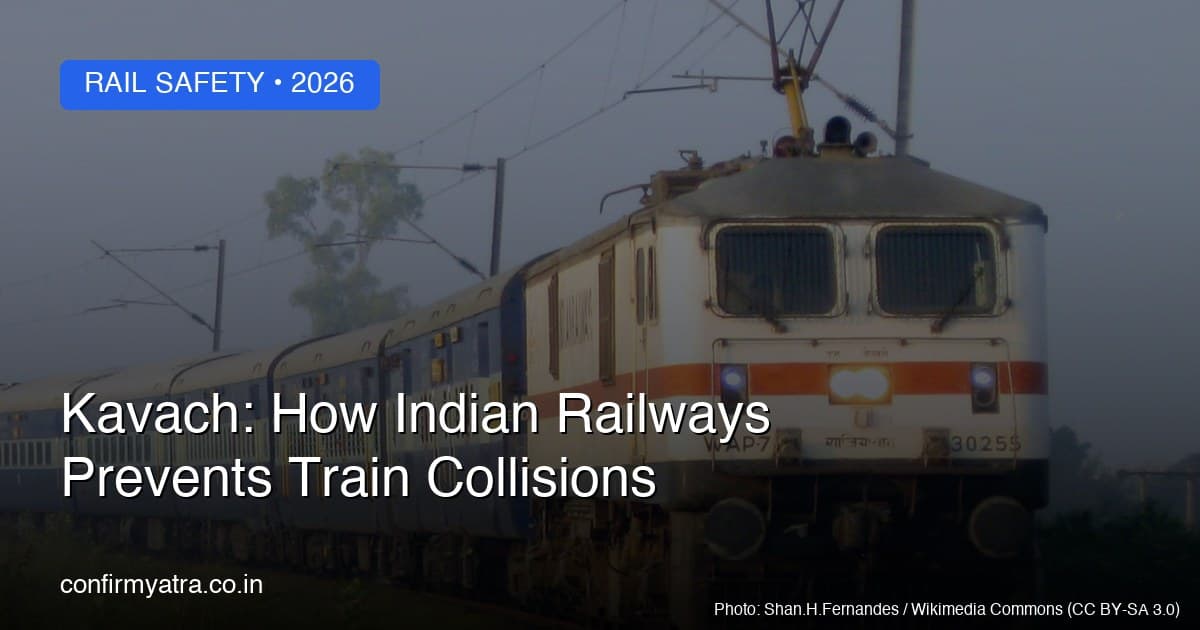
Picture two trains on the same track, moving toward each other in thick morning fog. The loco pilot of one train, for whatever reason, misses a red signal. In the old world, the only thing standing between those two trains and catastrophe was a human being noticing in time. Today, on a growing share of the Indian rail network, something else steps in first — a quiet electronic guardian called Kavach that slams on the brakes before the driver even reacts.
If you have seen the word Kavach in the news and wondered what it actually is, this is the plain-English explanation — how it works, where it is live in 2026, and why it matters for every passenger.
What Is Kavach?
Kavach, which means "armour" in Hindi, is India's indigenously developed Automatic Train Protection (ATP) system. In simple terms, it is a safety net that continuously watches a train's speed and position and can automatically apply the brakes if the train is about to do something dangerous — like pass a red signal or head toward another train on the same line.
It was developed by the Research Designs and Standards Organisation (RDSO) along with Indian companies Medha Servo Drives, Kernex Microsystems and HBL Power Systems, and it was adopted as India's National ATP System back in July 2020. Kavach is certified to SIL-4, the highest internationally recognised Safety Integrity Level — the same class of reliability demanded of the most safety-critical systems in the world.
The key idea to hold onto: Kavach does not wait for the driver. It acts on its own when the numbers say danger.
Why India Built Kavach
For decades, Indian train safety rested almost entirely on the alertness of the loco pilot — reading signals, judging speed, reacting to fog. Human beings are remarkable, but they get tired, visibility drops, and mistakes happen. The most feared category of railway accident, a head-on or rear-end collision between two trains, almost always traces back to a signal being missed.
Kavach exists to remove that single point of failure. By putting an automatic, always-awake system in the loop, Indian Railways is trying to make the most dangerous type of accident close to impossible on equipped routes — not by blaming drivers, but by backing them up.
How Kavach Actually Works
Here is what Kavach does, in the situations that matter most:
- Stops a Signal Passed at Danger (SPAD). If a train approaches a red signal and the driver does not begin braking, Kavach applies the brakes automatically. This is the big one — SPAD is the classic cause of collisions.
- Prevents two trains colliding on the same line. Trackside and onboard Kavach units talk to each other. If two Kavach-fitted trains end up on a collision course on the same section, the system brakes both before they can meet.
- Controls over-speeding. If a train exceeds the safe speed for that stretch of track — a curve, a station approach — Kavach automatically reins the speed back in.
- Gives the driver signals inside the cab. Kavach displays the upcoming signal aspect right on a screen in the locomotive cabin. In dense fog or heavy rain, when the driver simply cannot see a trackside signal, this in-cab display keeps the train running safely instead of crawling blind.
- Sounds the horn automatically at level crossings, so the driver does not have to remember every unmanned crossing.
- Has an SoS function to flag emergencies and warn nearby trains quickly.
None of this replaces the loco pilot — it sits beneath them as a backstop, taking over only in the split second when doing nothing would be dangerous.
Where Kavach Is in 2026
Kavach is being rolled out across the network in its latest version, Kavach 4.0, and the pace has picked up sharply. A snapshot of where things stand:
| Milestone | Status (2026) | |
|---|---|---|
| Version deployed | Kavach 4.0 (enhanced accuracy, easier integration) | |
| Route km live | ~3,100 route km commissioned as of early 2026 | |
| Work underway | 24,000+ additional route km in progress | |
| Rollout target | 5,000–5,500 route km per year going forward | |
| Single-day record | 472 route km commissioned in one day (Jan 2026) |
The honest picture: Kavach is real and expanding fast, but India's rail network is enormous — over 68,000 route km — so full coverage is a multi-year project, not something already finished. High-density and high-priority corridors are being covered first.
What Kavach Means for You as a Passenger
For a traveller, Kavach is mostly invisible — and that is the point. You will not see it working. But on a Kavach-equipped route, your train has an automatic layer of protection against the two scenarios passengers fear most: a missed signal and a same-line collision. It also means fewer weather-related delays, because trains can keep moving safely through fog using in-cab signalling instead of crawling.
It does not change anything you need to do. Your job is still the simple stuff — travel on a valid ticket, check your PNR status before you go, and track your train live so you know where it is. Our solo train travel safety guide covers the personal-safety habits that pair with the network-level protection Kavach provides.
Kavach vs Older Systems
India has tried anti-collision technology before, but Kavach is a generational step up: it is indigenous (so it is cheaper to deploy and maintain at national scale), it is SIL-4 certified, and version 4.0 is designed specifically for fast, large-scale rollout by integrating cleanly with the electronic interlocking already at stations. Earlier efforts were limited pilots; Kavach is a national standard with a funded, year-on-year expansion plan. You can read the technical background on the Kavach system reference on Wikipedia).
Frequently Asked Questions
What is Kavach in Indian Railways?
Kavach is India's indigenously developed Automatic Train Protection (ATP) system. It continuously monitors a train's speed and position and automatically applies the brakes if the train risks passing a red signal, over-speeding, or colliding with another train on the same line. It was adopted as India's National ATP System in 2020 and is certified to SIL-4, the highest safety integrity level.
How does Kavach prevent train collisions?
Kavach units on the train and along the track communicate continuously. If two Kavach-fitted trains are on a collision course on the same section, or a driver fails to brake for a red signal, the system automatically applies the brakes without waiting for the driver — closing the human-error gap that causes most collisions.
Is Kavach installed on all Indian trains?
Not yet. As of early 2026, Kavach 4.0 was live on roughly 3,100 route kilometres with over 24,000 more under way, and a target of 5,000–5,500 route km per year. India's network is over 68,000 route km, so full coverage is a multi-year rollout that prioritises busy and high-risk corridors first.
Does Kavach work in fog and bad weather?
Yes — this is one of its most useful features. Kavach shows the upcoming signal inside the locomotive cab, so in dense fog or heavy rain, when the driver cannot see trackside signals, the train can keep running safely instead of slowing to a crawl.
Does Kavach replace the train driver?
No. Kavach is a backup, not a replacement. The loco pilot drives the train as normal; Kavach only intervenes in the moment when not acting would be dangerous — such as applying the brakes for a signal the driver has missed.
Which trains and routes have Kavach in 2026?
Kavach is being deployed corridor by corridor, starting with high-density and high-priority routes across several railway zones under the Kavach 4.0 programme. Coverage is expanding every month, so whether a specific route is equipped depends on the rollout schedule for that section.
Wherever your train runs, ConfirmYatra keeps you informed — check your PNR status, track your train live, and search trains with confidence.
Plan your journey with ConfirmYatra
Free real-time tools for Indian Railways travellers.